


The architecture of a nation is built upon its constitution—the supreme law that dictates how power is distributed and how citizens are protected. While many nations share historical DNA, the practical application of their laws often tells two very different stories. From the birth of the U.S. Constitution in the 18th century to Nigeria’s modern struggle with federalism, the evolution of governance remains a complex study in power.
The American Foundation: Separation as a Shield
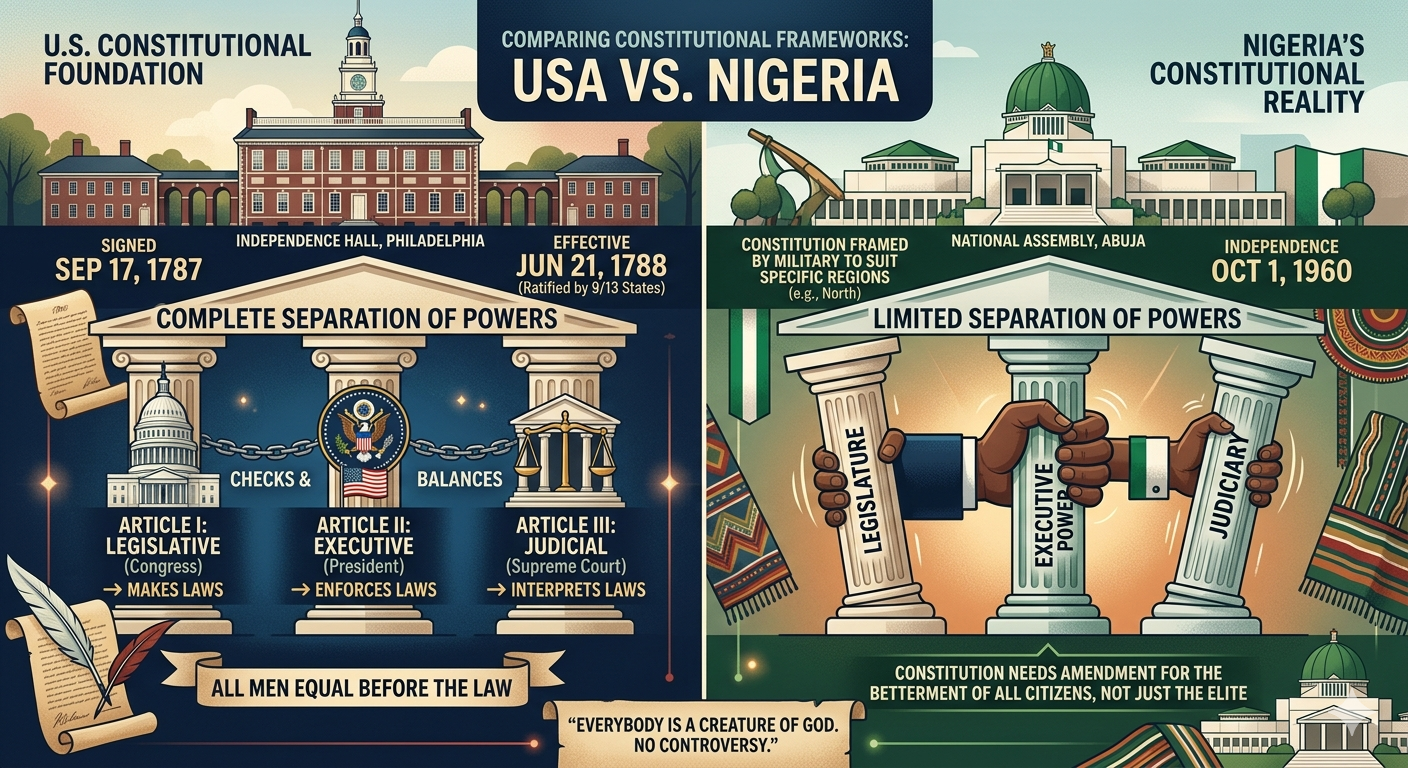
The United States Constitution was signed on September 17, 1787, in Philadelphia, though it didn’t officially take flight until June 21, 1788, following ratification by nine of the original thirteen states. Designed for a vast and growing territory, the framers rejected the British “Cabinet” or Parliamentary system in favor of a Presidential system.
The core of the American experiment is the strict Separation of Powers, clearly demarcated by the first three Articles of the Constitution:
| Article | Branch of Government | Primary Function |
| Article I | The Congress (Legislative) | Creation of Laws |
| Article II | The President (Executive) | Execution of Laws |
| Article III | The Supreme Court (Judicial) | Interpretation of Laws |
This structure ensures that no single branch becomes tyrannical. The concept of “Checks and Balances” is not just a theory but a functional reality that protects the principle that all men are equal before the law.
Nigeria: A Mirror with Distortions
Nigeria’s journey to self-rule culminated in independence on October 1, 1960. Despite being a former British colony, Nigeria eventually moved away from the British model—similar to India, which gained independence earlier on August 27, 1947, yet retained a Parliamentary system despite its massive size.
Nigeria chose to follow the American Presidential model, largely because of its diverse and expansive geography. However, the Nigerian reality often contradicts the American blueprint:
- Military Influence: Unlike the U.S. document born of civil debate, Nigeria’s current constitutional framework was heavily influenced by military regimes. This has led to criticisms that the document was framed to favor specific regions (the North) rather than the collective whole.
- Blurred Lines of Power: While Nigeria technically has legislative, executive, and judicial arms, the “Separation of Powers” is often fragile. In practice, the Executive branch frequently exerts significant influence over the Legislature and Judiciary, leading to a system where accountability is easily bypassed.
- The Equality Gap: A major point of contention is the application of justice. While the Constitution is meant to be the “supreme book” guiding all citizens, there is a pervasive sense that the law is used against the poor while the political elite remain untouchable.
The Path to Reform
The disparity between the American “ideal” and the Nigerian “practice” highlights a critical need for Constitutional Amendment. For Nigeria to truly flourish, the constitution must be refined to ensure it serves the betterment of the entire nation, rather than the interests of a select few.
“The constitution should be a shield for the many, not a sword for the powerful.”
Ultimately, the goal of any democratic constitution is to recognize that every citizen is an equal creature of God. Until the articles of the law are used to enforce true independence for the judiciary and legislature, the dream of a balanced federal republic remains a work in progress.




Great explanation